
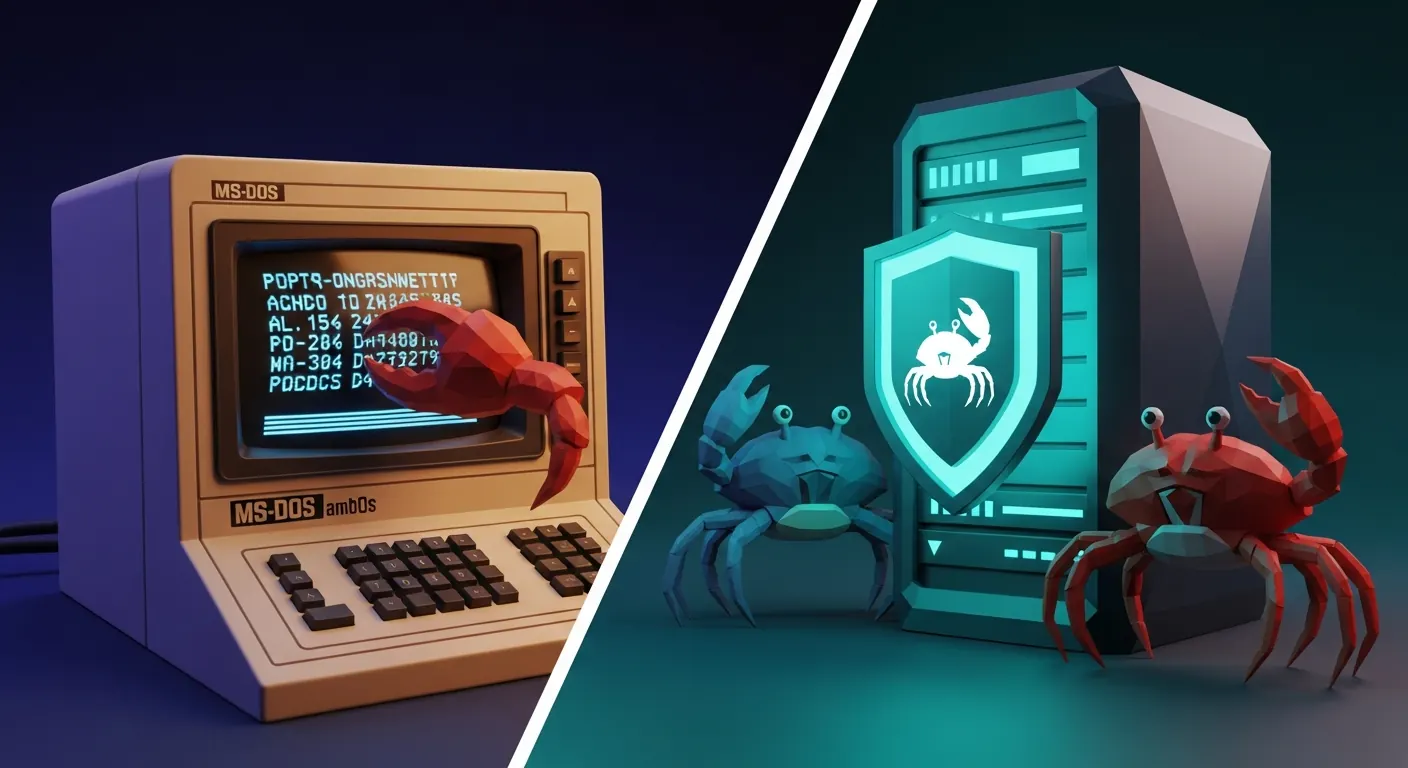
A single blog post published Monday on flyingpenguin.com ignited one of the most engaged OpenClaw community conversations in recent memory. Posted to Hacker News under the title "OpenClaw isn't fooling me. I remember MS-DOS," it climbed to 262 points with 294 comments by Monday evening UTC — easily among the most-discussed OpenClaw threads this month.
The Core Argument: MS-DOS All Over Again
The author — who is building an alternative agent gateway called Wirken — draws a sharp parallel between the current state of AI agent security and the pre-Unix era of MS-DOS. In that world, any program could "peek and poke the kernel, hook interrupts, write anywhere on disk." The fix, history showed, was not a better shell or a more careful wrapper. It was a fundamentally different architecture: process separation, virtual memory, ACLs, and privilege rings.
The argument applied to OpenClaw is that many AI agent gateways are making the same foundational error — sandboxing the whole agent in a container, rather than enforcing permissions at the tool layer:
"Agent gateways feel like we are racing backwards into the MS-DOS era. When you look at gateways out there they can hand the model an exec tool and trust it. One process, one token, with the LLM holding the line."
The NVIDIA NemoClaw Tutorial as a Case Study
The post uses NVIDIA's published NemoClaw + OpenClaw tutorial — which walks through deploying OpenClaw with NemoClaw on a DGX Spark — as evidence that the whole-agent-sandbox approach forces awkward compromises at every step:
- Bind Ollama to 0.0.0.0 — because the sandboxed agent cannot reach a loopback interface across its own network namespace.
- Pair via the chat channel — because there is no separate identity plane for secure key exchange.
- Approve connections at the network boundary — because the tool layer itself has no concept of permissions.
The author's framing: "Each of those is a compromise; response to a constraint. The constraint is worth revisiting."
What Wirken Does Differently
Wirken runs the gateway as a host process. Each channel gets its own Ed25519 identity. The vault runs out-of-process. Inference stays on loopback. Shell exec runs inside a hardened Docker container with capabilities dropped (cap_drop ALL), a read-only rootfs, 64MB tmpfs at /tmp, and no network access.
The post includes hash-chained audit logs from a live session showing the approach in action: a curl command denied at the tool layer before it ever touches a network boundary, and a sh compound command confirmed to be running against a read-only filesystem with an isolated tmpfs:
[ 4] assistant_tool_calls
     call: exec({"command":"curl https://httpbin.org/get"})
[ 5] permission_denied
     action_key='shell:curl' tier=tier3
[ 6] tool_result
     tool=exec success=False
     output: Permission denied: 'exec' requires tier3 approval.
The audit trail is hash-chained, not just logged — each turn's attestation covers the leaf hashes of all prior events in the session.
What the HN Thread Is Actually Debating
With 294 comments, this is not a one-note pile-on. The thread branches in several directions:
- Whether container-level sandboxing is good enough for most self-hosted OpenClaw deployments
- The practicality of per-tool enforcement vs. per-agent sandboxing, and what each trades off in usability
- Historical comparisons to how Unix/Linux enforced privilege separation, and whether that analogy even holds for AI agents
- Skepticism toward Wirken's own claims — the author is selling an alternative product, and HN noticed
The MS-DOS framing clearly resonated with an audience that remembers what happened the last time the industry sprinted ahead of its security architecture. Whether or not you agree with the conclusion, the engagement numbers suggest this is the kind of question the OpenClaw community is ready to take seriously.
Why This Matters for OpenClaw Users
OpenClaw's exec tool, gateway bearer token model, and channel-scoped permissions have been discussed in security-focused corners of the community before. This post puts the critique in a historical frame that is harder to dismiss than a standard bug report or CVE.
If you are running OpenClaw in a multi-user environment, on a shared server, or in any context where the exec tool is enabled and credential isolation matters — this thread is worth reading end-to-end.
The broader takeaway may simply be that the community is ready for a more structured conversation about what "secure by default" actually means for a self-hosted AI agent platform. OpenClaw's security posture has improved significantly across recent releases, but the fundamental architectural question the flyingpenguin post raises — sandbox boundary vs. tool-layer enforcement — is not one the release notes have addressed head-on.