
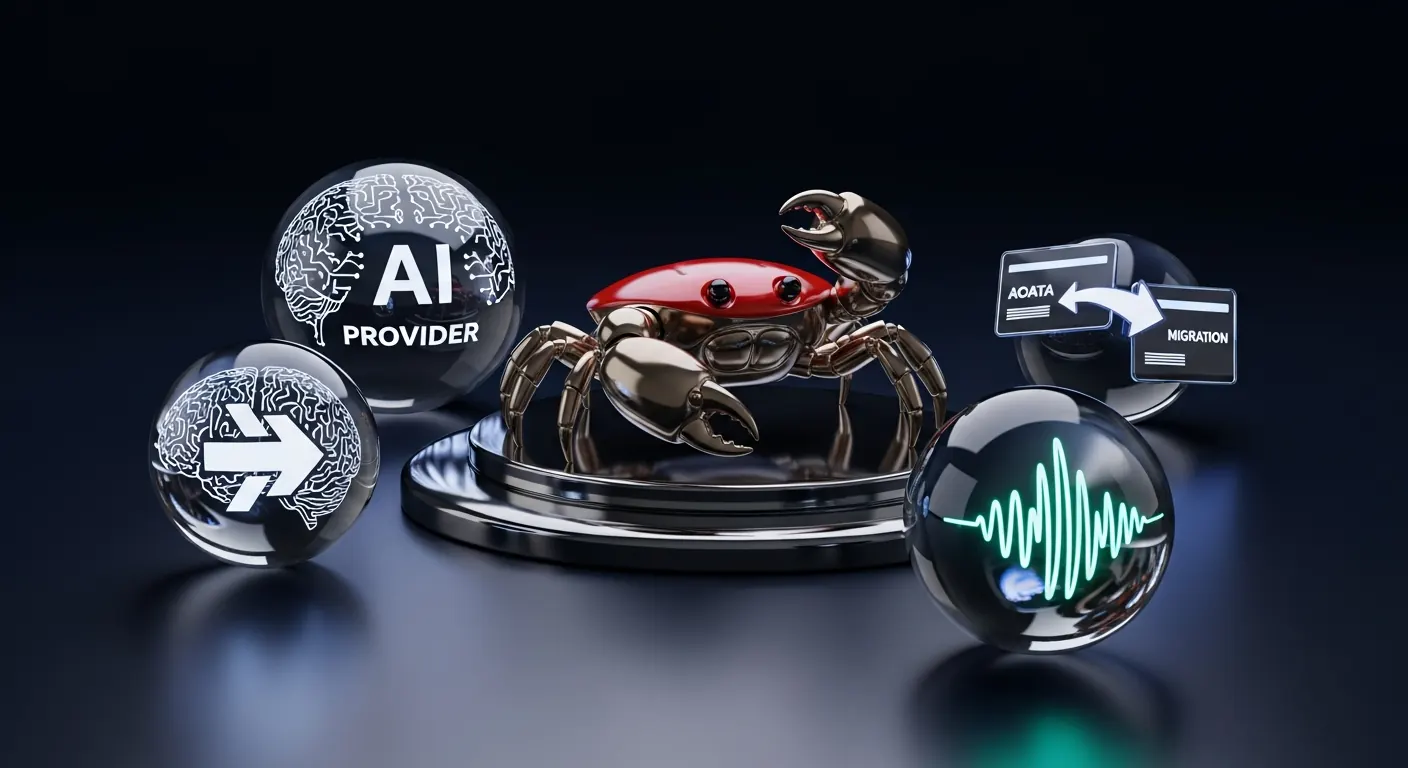
OpenClaw 2026.4.26 landed overnight with a release that covers a lot of ground: a new bundled AI provider, a proper migration story for users coming from Claude, real-time browser voice transport, and a clean config diff UI. There are also a couple of security fixes worth knowing about.
Here's what matters.
Cerebras Is Now a Bundled Provider
Cerebras — the company behind ultra-fast inference hardware — is now a first-class bundled provider in OpenClaw, complete with onboarding, a static model catalog, docs, and manifest-owned endpoint metadata. No plugin install required; it shows up during setup like any other built-in provider.
For users who have been waiting for Cerebras's speed advantages inside their local agent stack, this is a straightforward win. Just run openclaw setup or add it through the Control UI provider onboarding flow.
openclaw migrate: Import from Claude Code, Claude Desktop, and Hermes
This is the headline feature for anyone coming from the Anthropic ecosystem. A new top-level openclaw migrate command provides a full migration path with:
- Preview and dry-run mode — see exactly what will change before it happens
- Pre-migration backup — your existing config is archived automatically
- Claude importer — imports Claude Code and Claude Desktop instructions, MCP servers, skills, command prompts, and safely archives any state that needs manual review
- Hermes importer (contributed by @NousResearch) — imports configuration, memory/plugin hints, model providers, MCP servers, skills, and supported credentials from Hermes
The importer also detects first-run onboarding state so it doesn't trample a fresh install. Combined with --dry-run and --json output for scripting, this is a migration tool that was clearly built to be trustworthy, not just functional.
If you've been putting off moving your Claude-based setup to OpenClaw because the process felt manual and risky, that excuse is gone.
Browser Realtime Voice Transport
OpenClaw now ships a generic browser realtime transport contract that covers Google Live browser Talk sessions with constrained ephemeral tokens, plus a Gateway relay for backend-only realtime voice plugins. A companion fix ensures these sessions stay on WebSocket rather than falling back to WebRTC, and validates endpoint health before connecting.
This lays the groundwork for stable browser-based voice sessions without requiring a separate voice plugin or direct WebRTC peer setup. The Gateway relay path is particularly useful for self-hosters who want server-side audio handling rather than browser-native media APIs.
Raw Config Diff Panel in the Control UI
A new raw config pending-changes diff panel in the Control UI parses JSON5, redacts sensitive values until you explicitly reveal them, and cleanly avoids triggering fake raw-edit callbacks when you're just reviewing — not saving. It supersedes a couple of older PR attempts that had reliability issues.
This is the kind of UI change that sounds boring until you've accidentally applied a config you didn't mean to. Having a proper diff view before committing changes is a long-overdue quality-of-life improvement.
Matrix E2EE Setup in One Command
A new openclaw matrix encryption setup flow bootstraps Matrix encryption, sets up recovery, and prints verification status — all from a single interactive command. No more hand-rolling the encryption bootstrapping steps that previously required several manual Matrix client operations.
Security Fixes
Two fixes worth flagging:
Bearer token echo removed from device.token.rotate (#66773): Shared/admin device.token.rotate responses were previously echoing the rotated bearer token back in the response. That's fixed — the token is no longer included in the response while still allowing the same-device token handoff that token-only clients need before reconnecting. Thanks @MoerAI.
subagents.allowAgents enforcement tightened (#72827): Explicit sessions_spawn(agentId=...) calls targeting the same agent were being auto-allowed, bypassing the subagents.allowAgents policy check. This is now enforced consistently. Thanks @oiGaDio.
Neither is a critical CVE, but both close real policy bypass vectors — especially relevant if you're running OpenClaw in a multi-user or production environment.
Other Notable Fixes
The release includes a long tail of quality-of-life fixes across the board:
- Docker TLS fix (#72787): The slim Docker image now includes the CA certificate bundle, fixing HTTPS failures in containerized gateways after the bookworm-slim base switch.
- Bonjour/mDNS hostname conflict (#72355): The Gateway now defaults mDNS advertisements to the system hostname when DNS-safe, preventing
openclaw.localprobing conflicts on hosts like "Lobster" or "ubuntu". - Groq/LM Studio reasoning effort (#32638): Groq and LM Studio can now declare provider-native reasoning effort values, so Qwen thinking models get
none/defaultinstead of OpenAI-specificlow/mediumvalues. - WhatsApp proxy support (#72547): WhatsApp QR-login WebSocket connections now honor
HTTPS_PROXY/HTTP_PROXYgateway env vars, fixing connection failures on proxied networks. - Windows/Feishu path normalization (#72783): Bundled plugin and Feishu sidecar loads on Windows no longer fail with raw
C:ESM loader URL errors.
Updating
openclaw update
Full changelog: github.com/openclaw/openclaw/releases/tag/v2026.4.26