
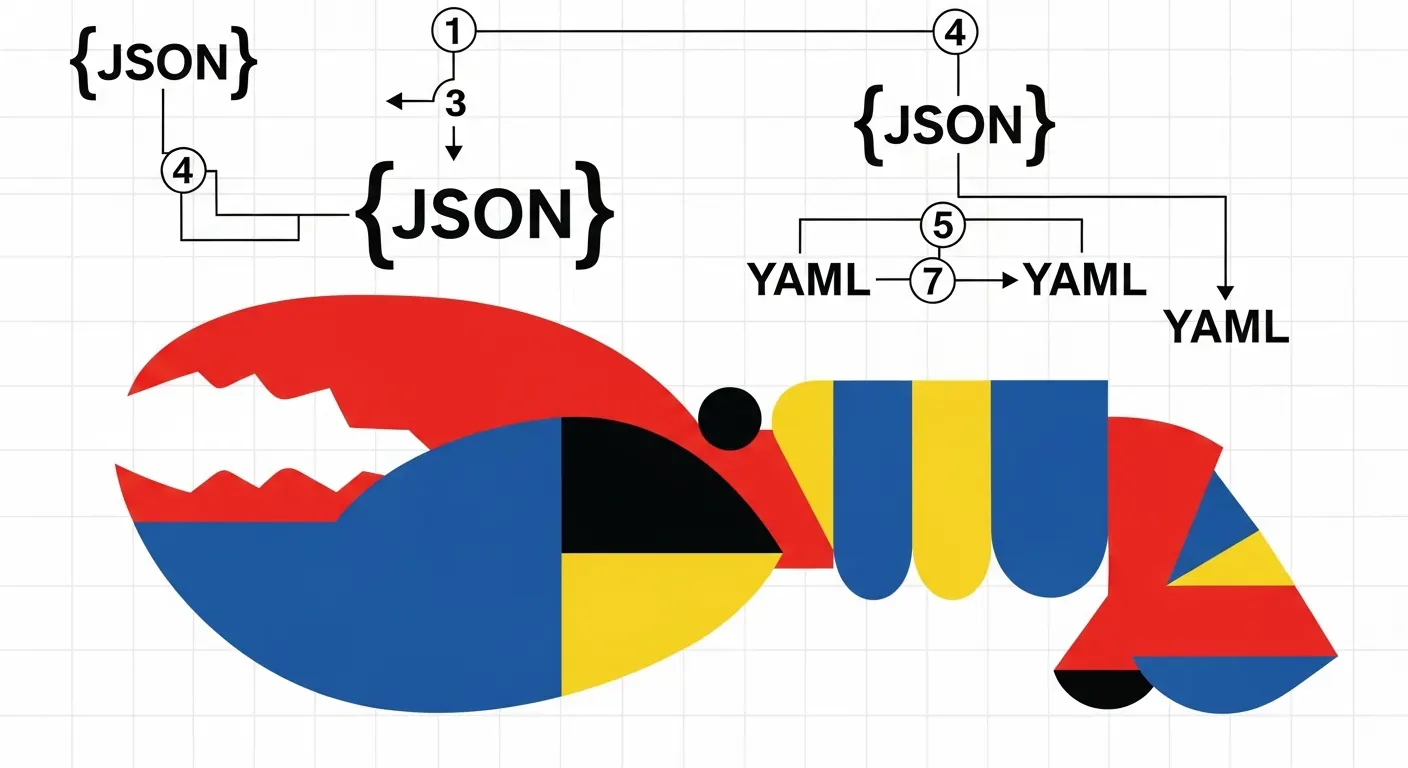
A significant new piece of infrastructure landed in the OpenClaw codebase this morning. Pull request #78678 merged the oc-path addressing substrate — a universal oc:// URI scheme for reading and writing structured content across every file format OpenClaw touches.
What Problem Does It Solve?
If you have ever written an OpenClaw plugin or skill that edits a config file, you have probably run into one of these frustrating bugs: JSON.stringify silently eats comments from JSONC files, frontmatter disappears after a Markdown parse, or a YAML emit changes key order and breaks a diff. These were not edge cases — they were reported across at least six separate GitHub issues going back years (#65623, #62438, #54310, #54311, #57091, #69475).
The oc-path substrate solves all of them at once by introducing a single addressing layer with byte-preserving round-trip emitters for every supported format.
The oc:// URI Grammar
The substrate introduces three universal verbs — resolveOcPath, setOcPath, and findOcPaths — that work identically regardless of whether the target file is JSON, JSONC, JSON5, JSONL, Markdown, or YAML.
The path grammar is expressive:
- 9 predicate operators —
=,!=,*=,^=,$=,<,<=,>,>= - Wildcards —
*for a single segment,**for recursive descent - Unions —
{a,b,c}to match multiple keys at once - Quoted segments —
"foo/bar"for keys that contain/,., or other reserved characters - Positional —
$first,$last,-Nfor index-based addressing - Ordinal —
#Nfor slug-collision disambiguation - Session scope —
?session=cron:dailyfor agent-session-scoped reads
Per-Format Round-Trip Emitters
Each supported file format gets its own parser and emitter that preserves everything a naive JSON.stringify or yaml.dump would destroy:
- Markdown — heading-section, item, table, and code-block addressing; frontmatter survives parse/emit intact
- JSONC — AST-preserving parser keeps comments, key order, and trailing commas through writes
- JSONL — line-addressed by
Lnnn,$first,$last, or-N, with per-line value descent and malformed-line skipping - YAML — uses the
yamlpackage's Document API to preserve comments and flow style
Safety Built In
The substrate includes several hardening measures:
- NFC normalization, BOM stripping, and a control-character ban with
\xNNprintable escapes - Hard limits:
MAX_PATH_LENGTH(4 KiB),MAX_SUB_SEGMENTS_PER_SLOT(64),MAX_TRAVERSAL_DEPTH(256) - An
OcPathErrorclass with stable machine-readablecodefields - A redaction-sentinel guard at every emit boundary, closing a regression where
__OPENCLAW_REDACTED__literals could end up written to disk
The implementation ships with 41 test files and 669 passing tests covering byte-fidelity, frontmatter edge cases, sentinel guards, real-world fixtures, and cross-kind property testing.
What Is Not in This PR
The PR author is explicit that CLI verbs (openclaw path resolve, find, validate, set) are coming in a follow-up PR. The same goes for the workspace classifier, manifest builder, and the @openclaw/plugin-sdk re-export. What landed today is the core substrate — the internal library every subsequent piece will build on.
Why This Matters for Plugin Authors
Until now, OpenClaw plugins that needed to read or write structured files had to roll their own parsers or reach for general-purpose libraries that were not aware of OpenClaw's format conventions. The oc-path substrate gives the whole ecosystem a shared, tested, safe substrate — and one that will eventually be exposed through the plugin SDK once the API stabilizes.
Watch the openclaw/openclaw repository for the follow-up PR that adds the user-facing CLI verbs.