
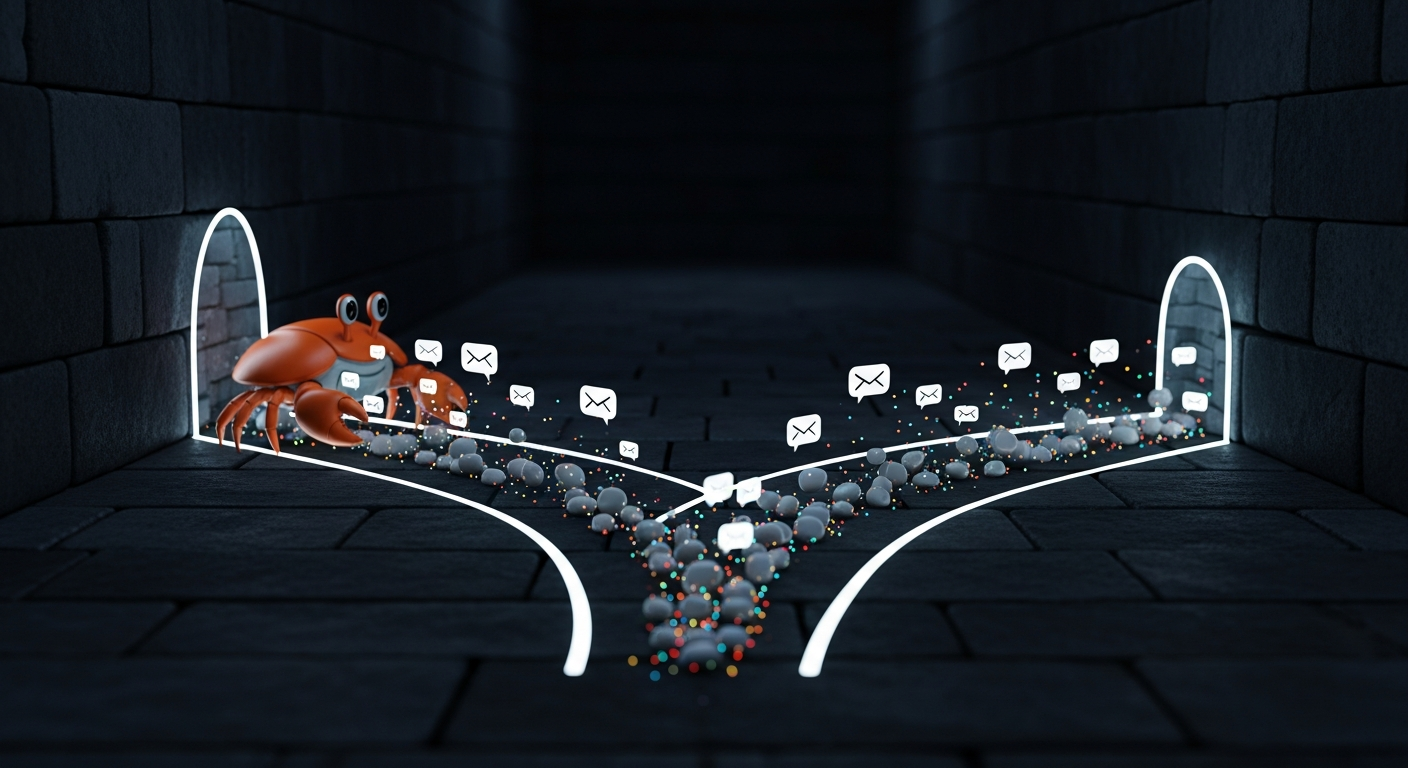
OpenClaw merged a high-priority channel-routing fix tonight in PR #123316, titled "fix: keep global channel events scoped to their agent." The change targets a subtle but serious multi-agent edge case: Slack or Discord system events could be delivered to a sibling agent after the producing channel had already resolved the correct route.
That matters because OpenClaw installations increasingly run more than one agent under the same operator. A global queue is useful for shared infrastructure, but it should not erase the ownership decision that has already happened at the channel boundary.
What Went Wrong
The PR describes the bug as a case where "multi-agent installations using global session scope could deliver Slack or Discord system events to a sibling agent after the producer had already selected the correct route." In other words, the channel knew which agent should receive the event, but the enqueue path did not preserve enough route ownership metadata when the work entered the shared queue.
That is especially risky for system events. These are not ordinary chat messages where the human can immediately spot a wrong reply. They can represent channel lifecycle facts, notification state, or background routing signals. If those facts land in the wrong agent's context, the next action can be confusing even when no external message is sent.
The Fix
The merged change adds a narrow Plugin SDK enqueue path that carries the resolved route owner through existing system-event metadata. The bundled Slack and Discord channel producers were migrated to that path, and Slack now retains the full route instead of falling back to a default.
The important boundary is that literal-global queue behavior remains intact. OpenClaw still supports globally scoped queues, but already-routed events stay attached to their selected owner. If a route is genuinely unbound, the system fails explicitly rather than silently leaning on a global default.
The PR's evidence says the pre-fix reproduction showed one agent consuming another agent's event. The new regression leaves the event queued for the correct agent until that agent drains it.
Why Operators Should Care
This is a reliability fix, but it is also an authority fix. In a single-agent setup, the bug may never surface. In a multi-agent setup with Slack and Discord connected, though, a route slip can make agents appear haunted: one agent reacts to another agent's system context, while the intended recipient misses the event it needed.
The new behavior is simpler to reason about:
- Slack and Discord producers preserve the selected route.
- Shared global queues do not override that route.
- Unbound routes fail instead of guessing.
- Multi-agent installs do not need a broad global default for already-routed events.
The Bottom Line
PR #123316 is a good example of OpenClaw hardening the channel layer as multi-agent use becomes normal. The fix keeps Slack and Discord system notifications scoped to the chosen agent, even when the underlying queue is shared, reducing cross-agent confusion without removing the global-queue model.