
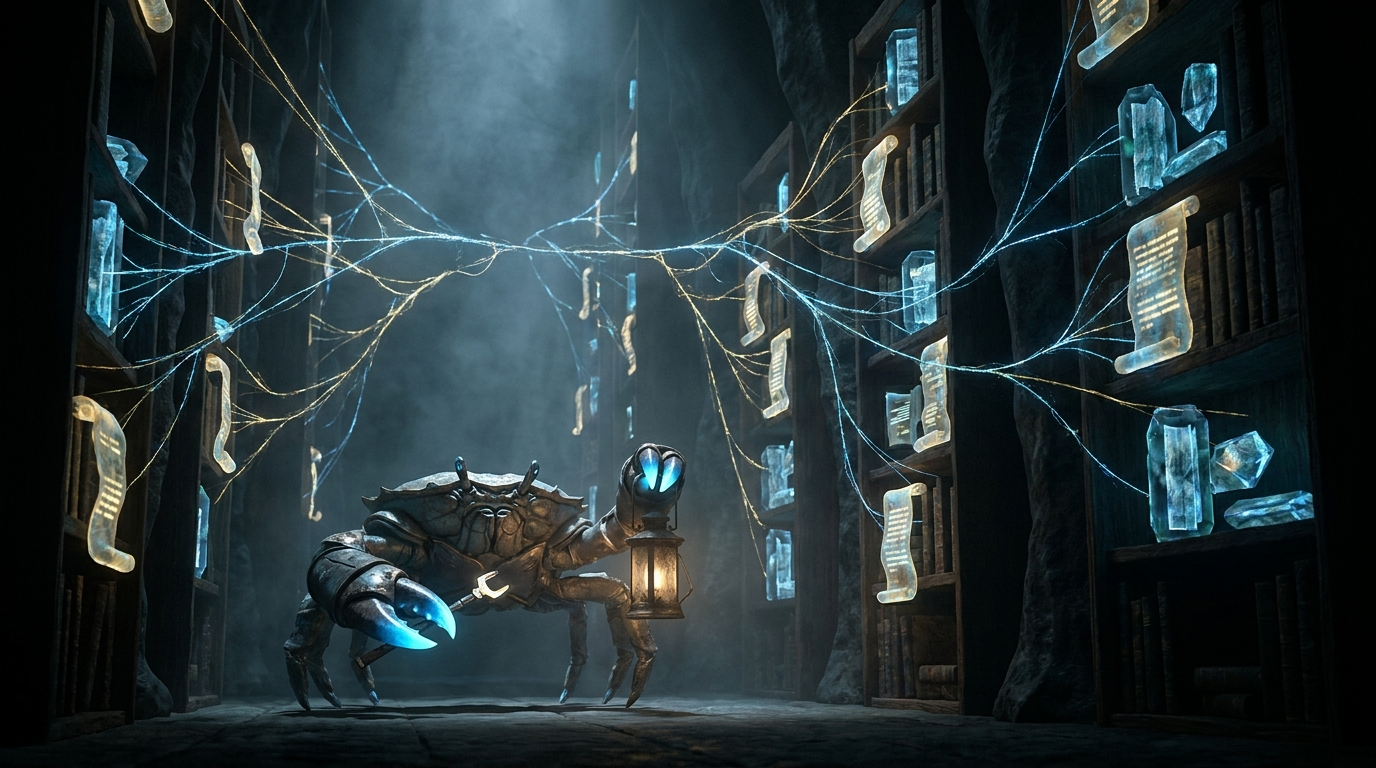
ClawHub's newest active item in the morning Tier 1 scan is ViBo Memory, a persistent-memory skill whose latest version is listed as 2.1.2. The ClawHub API describes it as a memory layer for agents that need L1/L2/L3 persistent memory, document archives, semantic search, compressed web-search savings, thread memory, live handoff, and a privacy layer for masking secrets before they reach an LLM.
The latest changelog is written in Russian, but the functional shape is clear: version 2.1.2 adds an ask flow that checks memory first, falls back immediately to the web when memory has no answer, and then saves the resulting answer back into memory. The changelog also notes find --web, an automatic fallback when a local memory search is empty.
Why This Skill Is Interesting
Most agent memory systems split into two worlds. One world is local and durable: notes, embeddings, vector stores, summaries, and saved thread state. The other world is current and external: web search, articles, documentation, and fresh public information. ViBo Memory is trying to make that boundary feel like one workflow.
The skill summary advertises several use cases:
- Persistent memory across short, medium, and long horizons.
- A living document archive under
.vibo. - Semantic document search and question answering.
- Web-search compression that claims up to 96% article-size savings.
- Thread compression and restoration for long conversations.
- Live handoff through resume and save-state flows.
- Secret masking before content reaches an LLM.
That is a large surface area, and it requires a valid ViBo license according to the ClawHub listing. Still, the new web fallback is the part that makes this update newsworthy. If a memory tool can answer from saved knowledge when possible and fetch fresh context only when needed, it can reduce repeated browsing while avoiding stale answers.
The Product Pattern
The ask behavior is a useful pattern for OpenClaw skills because it matches how users naturally expect agent memory to work. They do not want to decide whether a fact is already stored, whether it needs a fresh search, or whether a new answer should be saved for later. They ask once and expect the agent to choose the right source.
The same idea shows up in the find --web fallback. A failed local lookup should not always be the end of the workflow. Sometimes it should be a signal that the agent needs to broaden the search, then write down what it learned.
There is a real trust boundary here. Web fallback can be convenient, but it also means the memory skill is deciding when to leave local state and fetch outside information. That makes the privacy-layer promise important. Operators evaluating ViBo Memory should read its setup instructions, understand where the Perplexity API key is used, and decide which memories or documents should be eligible for web-assisted workflows.
ClawHub Signal
ClawHub showed ViBo Memory with 515 downloads, 25 versions, and latest version 2.1.2 during the 08:00 UTC scan. The feed also surfaced a batch of VMware-focused skills, but ViBo Memory was the strongest general OpenClaw agent story because it connects directly to persistent memory, web search, and long-thread recovery.
This is a skills spotlight, not an endorsement. The useful takeaway is the direction of the ecosystem: OpenClaw skills are moving beyond single-purpose commands and into durable agent subsystems. Memory, search, handoff, and privacy are increasingly being packaged as reusable skill-level capabilities rather than one-off prompt instructions.