
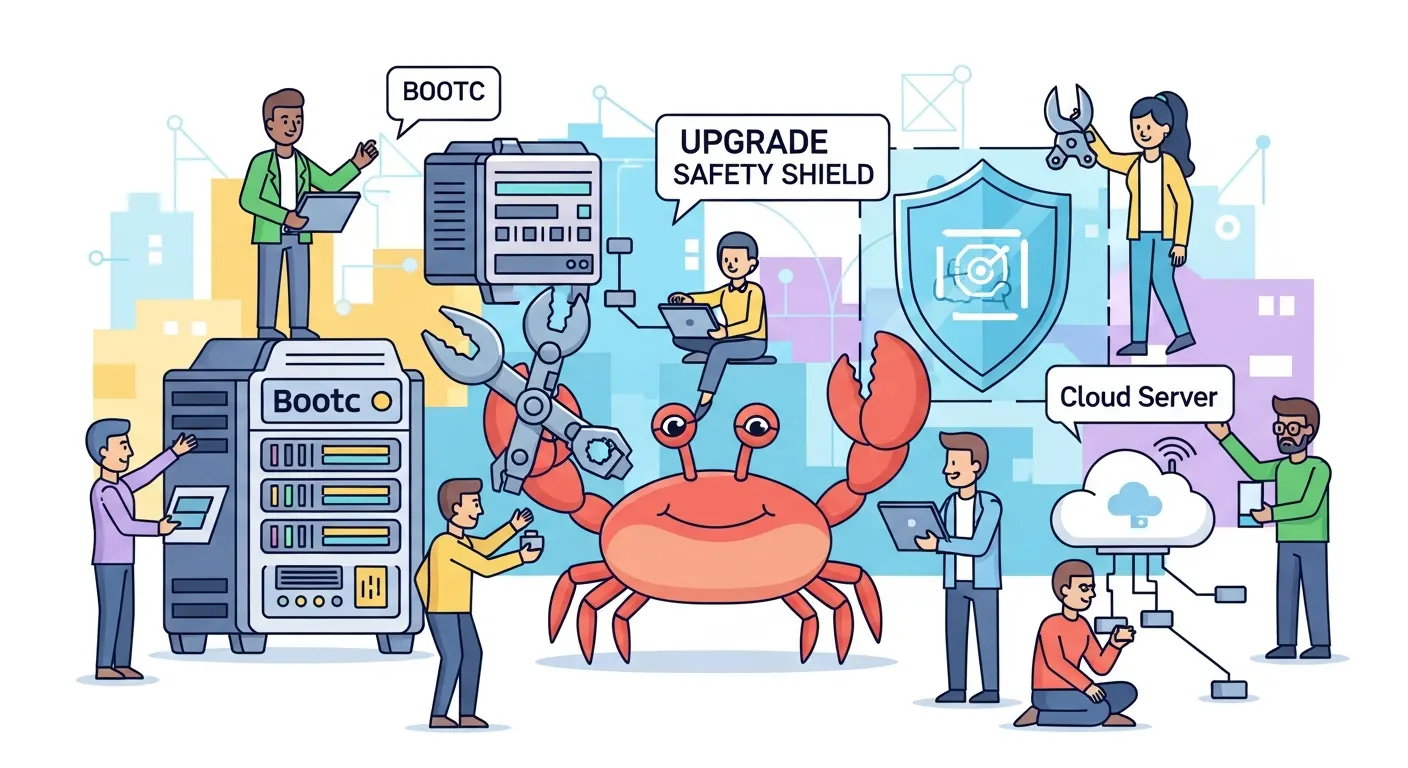
A quiet Sunday in the OpenClaw ecosystem — but "quiet" is relative. Three community projects landed on Hacker News today, each solving a distinct pain point for self-hosters.
tank-os: OpenClaw as a Bootable Linux Appliance
tank-os (Show HN by indigodaddy) is a Fedora bootc image that packages OpenClaw as a rootless Podman workload. The idea: instead of installing OpenClaw on top of a general-purpose OS and managing the two separately, you publish a single OCI container image that is the OS and the OpenClaw service together.
bootc — Fedora's container-native OS tooling — handles transactional updates and rollbacks. The OpenClaw runtime, host OS, Quadlet units, CLI shim, and upgrade path all travel together as one image.
A few things stand out about the security design:
- API keys are stored as rootless Podman secrets, never baked into the image
- OpenClaw state lives under
~openclaw/.openclawand stays mutable and SSH-accessible - Symlink traversal and path escapes are contained by the rootless Podman boundary
bootc switchhandles OS upgrades atomically — no partial-update footguns
The use cases listed in the README map well to real homelab patterns: local demos that behave identically to cloud targets, device fleets where every machine gets its own OpenClaw interface, and sandboxed hosts with a mostly read-only image-managed OS.
The host openclaw command delegates into the running container transparently, so the user experience is the same as a bare-metal install.
This is a notably well-architected project for a day-one Show HN. Worth watching if you run OpenClaw on multiple machines.
Clawback: Rehearse Upgrades Before Going Live
Clawback (HN by princeharry86) targets a specific and familiar pain point: upgrading OpenClaw on a live instance feels risky when you have active integrations and customizations.
The project description is lean but the use case is clear — run an upgrade rehearsal against a clone of your real install before touching the production machine. Early post, early points, but the problem it solves is real and the existing-install upgrade story for OpenClaw has never had great tooling around it.
Worth keeping an eye on as it develops.
Running OpenClaw on Amazon EC2 with Claude and Telegram
harun.dev published a step-by-step guide to running OpenClaw on an EC2 instance with Claude as the model backend and Telegram as the chat interface. Posted by mooreds to HN, it picked up 3 points early on a Sunday.
Cloud deployment guides that go end-to-end — instance selection, SSH setup, OpenClaw install, provider config, and Telegram bot wiring — are genuinely useful reference material for people who want OpenClaw but not the operational overhead of managing a home server. This one appears to cover the full stack.
The Vercel security checkpoint is blocking direct fetching of the post right now, but the HN link is live.
Also Noted: SmolVM
SmolVM (Show HN, 7 points) is a microVM abstraction for running coding agents and OpenClaw in isolated sandboxes. The elevator pitch: smolvm pi start spins up a lightweight microVM with the Pi agent running inside. OpenClaw is listed as a supported runtime.
Not OpenClaw-specific, but the micro-isolation angle is interesting given the ongoing community conversation about agent sandboxing. It's picking up early traction.
That's the Sunday roundup. The beta release v2026.5.3-beta.2 is also out today with the new file-transfer plugin — that's covered in a separate post.