
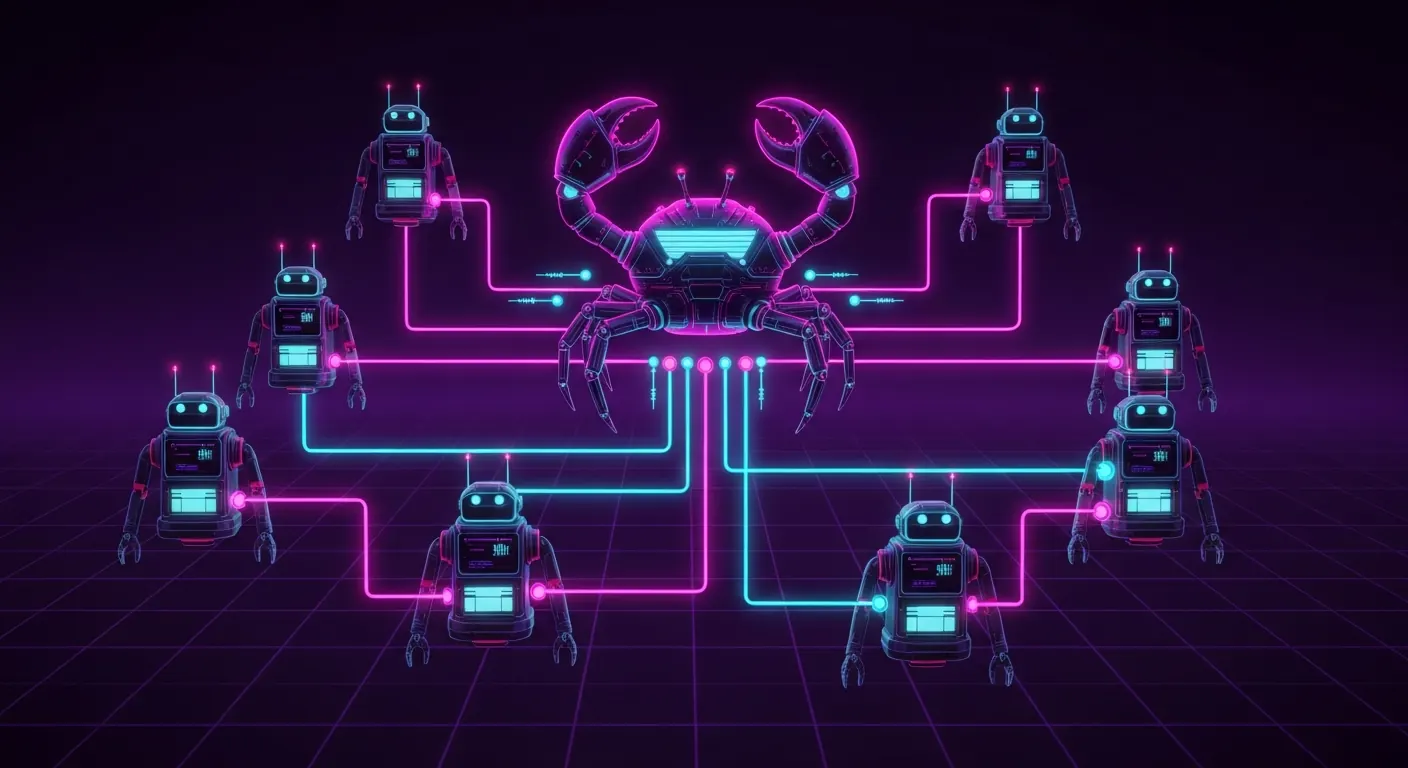
A Show HN post from last night caught our attention: Mercury (mercury.build), a new a16z-backed agent orchestration platform, lists OpenClaw as a first-class supported agent type alongside Claude Code, Devin, Manus, and Gumloop.
This is a notable signal for the OpenClaw ecosystem. It means teams building multi-agent systems are already treating OpenClaw as a peer to purpose-built coding agents in the orchestration layer.
What Mercury Does
Mercury is a visual canvas for connecting human and AI agent teams. You draw edges between agents to define delegation relationships — Agent A can delegate to Agent B, which can delegate further down the graph. The canvas becomes a live map of how your team operates.
The founder's pitch centers on a problem anyone who has run multiple agents knows well: "You've got Claude Code in a terminal, a research agent in a browser tab, a Slack bot somewhere else, a scheduling assistant in yet another window. It's chaotic."
Mercury aims to solve the coordination problem, not the individual-agent problem.
OpenClaw as an Adapter
Mercury supports several agent types on the same canvas:
- Native Mercury agents — built on the Anthropic SDK
- Adapters for Claude Code, Devin, Manus, OpenClaw, Gumloop
- MCP-compatible agents via the MCP protocol
The OpenClaw adapter means you can connect your existing OpenClaw instance to a Mercury canvas and have it receive delegated tasks, process them with its full tool stack, and return results to orchestrating agents or humans.
This fits naturally with how OpenClaw works — it already handles delegation internally through its sub-agent system. Being a node in a larger Mercury-managed graph extends that pattern to cross-tool teams.
Why This Matters
OpenClaw being included at launch (not added later) suggests the Mercury team built against it deliberately. The platform integrates 800+ tools via Composio, supports iMessage and Slack as human-facing channels, and has human-in-the-loop approval by default — all patterns familiar to OpenClaw users.
The a16z backing ($1.5M seed, with investors from OpenAI and Cognition) gives Mercury some runway to ship. Whether it finds product-market fit is TBD, but the fact that an a16z portfolio company is shipping OpenClaw support from day one is a sign of where the ecosystem is heading.
The Memory Architecture Question
The most interesting part of the Show HN post is the question the Mercury team is wrestling with publicly:
"Where should memory live — in the orchestration layer or the agent layer?"
It's a genuinely hard problem. OpenClaw's approach leans toward the agent layer — memory lives close to the agent that uses it, with recall running right before each reply (especially now that Active Memory shipped in 2026.4.12). Mercury started with org-level memory exposed as tools, but acknowledges that's not right for every agent.
This is an open design question for the entire multi-agent space. Worth watching as both platforms evolve.
Try Mercury
Mercury is in alpha: mercury.build. If you're running OpenClaw and want to connect it to a larger agent graph, it's worth a look.