
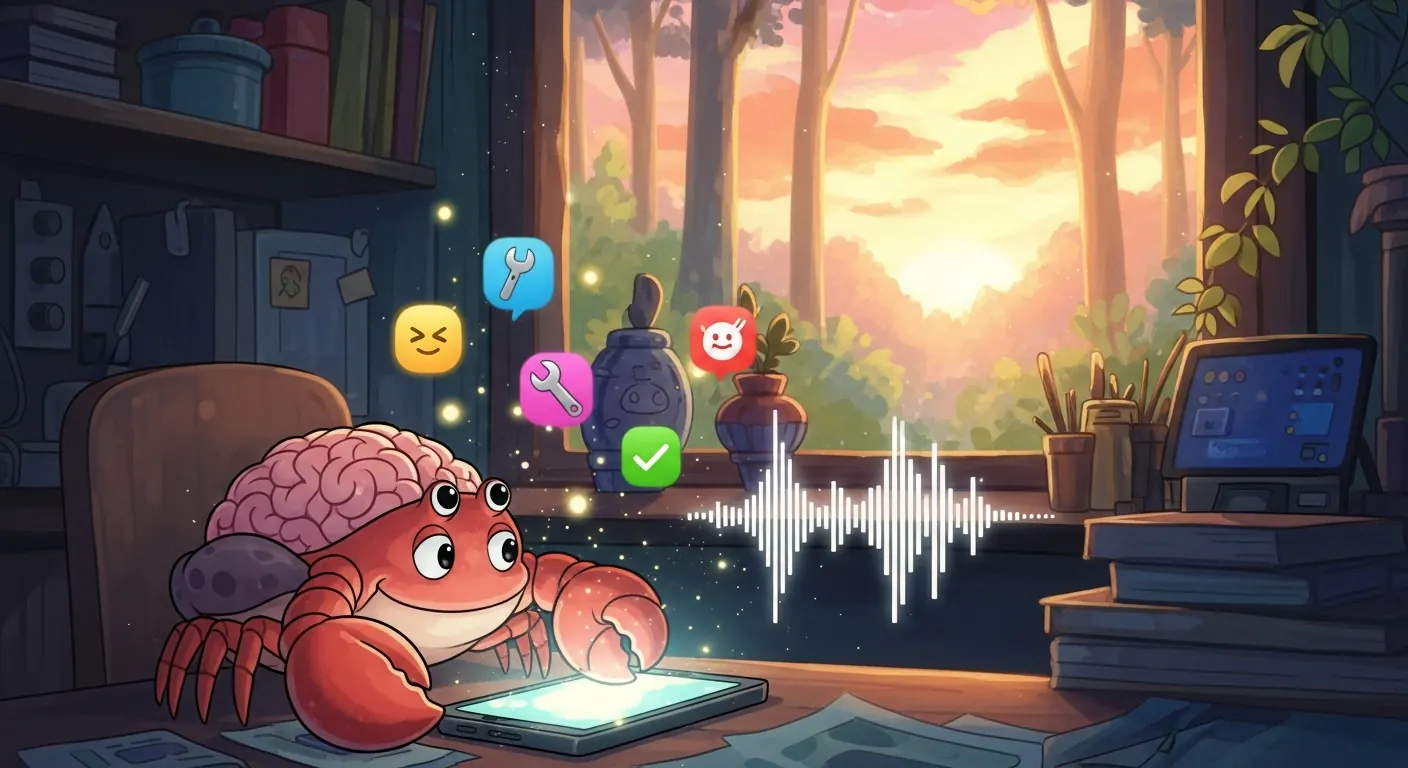
OpenClaw v2026.5.14-beta.1 dropped late on May 14th, just hours after the v2026.5.12 stable release. It's a notably feature-rich beta — several of its changes address long-standing quality-of-life gaps, and at least two are significant enough that WhatsApp and voice-call users should take notice immediately.
WhatsApp Finally Gets Status Reactions
WhatsApp users have been watching Telegram and Discord users enjoy the full status reaction lifecycle — thinking, tool use, done, error — while getting nothing on their end. That gap closes in this beta.
StatusReactionController is now wired into WhatsApp message turns (#80612), bringing the complete lifecycle to WhatsApp. The default emoji set has also been overhauled across all channels to be self-explanatory rather than emotional:
- 🧠 thinking
- 🛠️ tool use
- 💻 coding
- 🌐 web browsing
- ⏳ stall (soft)
- ⚠️ stall (hard)
- ✅ done
- ❌ error
- 🗜️ compacting
This is particularly useful for WhatsApp users who previously had no indication whether their agent was actively processing or silently hung. The fix also resolves #59077, which had been open for quite a while.
Telnyx Realtime Voice Calls
OpenClaw now supports realtime media-streaming conversational voice calls via Telnyx (#81024). This is distinct from the existing TTS playback capability — it's a live bidirectional voice session, similar to what OpenAI's Realtime API enables but routed through Telnyx's telephony infrastructure.
If you're building an agent that handles actual phone calls — intake, scheduling, support queues — this is the integration to watch. The voice call webhook path has also been hardened in this beta to reject malformed Host headers before provider signature checks, closing a class of potential abuse.
Subagent Tasks Are Now Auditable
A meaningful change to how subagent delegation works. Previously, when a parent session spawned a subagent via sessions_spawn, the child's task was embedded in its system prompt — invisible to session history and impossible to audit after the fact.
This beta delivers the subagent task as the child session's first visible [Subagent Task] message (#78592). The full task description is now part of the session transcript, making delegation auditable without consuming extra tokens through system prompt duplication. For anyone running multi-agent workflows where accountability matters, this is a welcome change.
Mid-Turn Steering Is Now Default
The behavior that lets you redirect an active agent run with a new prompt while it's still running (/queue steer) is now the default for mid-turn messages (#77023). Previously, sending a message during an active run queued it to run afterward.
Users who prefer the old queue-and-wait behavior can restore it with /queue followup or /queue collect. The /steer command itself now falls back gracefully to a normal prompt when steering isn't applicable — no more errors when the run already finished by the time your steering message arrived.
DeepSeek V4 Flash Local Config Docs
The OpenClaw docs gain a dedicated page for DeepSeek V4 Flash running locally, covering on-demand startup configuration, context sizing, and live verification steps. If you've been experimenting with DeepSeek as a local model backend, the setup path is now significantly clearer with documented first-party guidance.
isHeartbeat Flag on Agent Events
Gateway event payloads now carry an optional isHeartbeat flag (#80610) that lets clients distinguish scheduled heartbeat runs from ordinary user conversations. This is useful for dashboards, analytics pipelines, or monitoring tools built on top of the gateway event stream — you can now filter routine background activity from real interactions without pattern-matching on message content.
Also in This Beta
- Telegram Mini App button support in
openclaw message send --presentation, allowing Web App inline buttons in private chats (#81356) - Agents
runRetriesconfig at bothagents.defaultsand per-agent level for embedded Pi runner retry loop limits (#80661) - Codex CLI session continuation from an OpenClaw conversation — you can now bind and continue an existing Codex CLI session running on a paired node
Getting the Beta
npm install -g openclaw@beta
# or pin to this specific build
npm install -g openclaw@2026.5.14-beta.1
Full changelog on the GitHub releases page.