
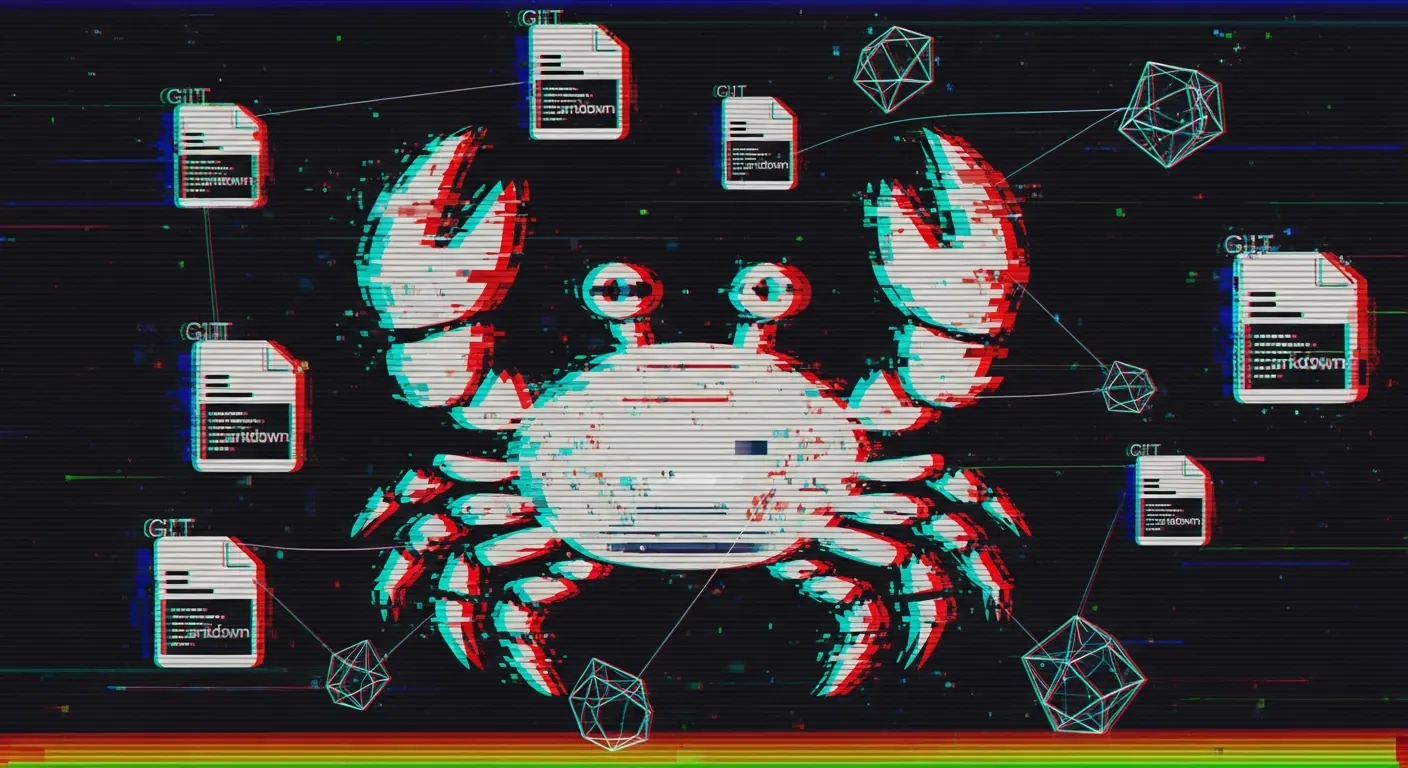
A new open-source project called WUPHF — a collaborative office and persistent wiki layer for AI agents — hit Hacker News yesterday and climbed to 251 points with 111 comments. Its core pitch: give AI agents like OpenClaw, Claude Code, Codex, and OpenCode a durable knowledge substrate built on Markdown and Git, without reaching for Postgres, pgvector, or a graph database.
The full Show HN thread and source code are at github.com/nex-crm/wuphf.
The Problem It Solves
Most agent setups today lose context between sessions. Knowledge gets re-pasted every morning, or agents start cold without any accumulated understanding of the project or user. The typical solutions — vector databases, graph stores, structured datastores — add considerable infrastructure overhead.
WUPHF takes a different bet: how far can Markdown + Git go before you need anything heavier? The answer, based on their benchmark of 500 artifacts and 50 queries, is surprisingly far: 85% recall@20 on BM25 alone, which is their internal ship gate. sqlite-vec is the pre-committed fallback if a query class drops below that threshold.
How It Works
Each agent in WUPHF gets a private notebook at agents/{slug}/notebook/*.md, plus access to a shared team wiki at team/. The architecture is straightforward:
- Draft-to-wiki promotion: Notebook entries pass through a review step (agent or human) before landing in the canonical wiki with a back-link. A state machine drives expiry and auto-archive.
- Entity fact logs: Per-entity append-only JSONL files at
team/entities/{kind}-{slug}.facts.jsonl. A synthesis worker rebuilds entity briefs every N facts. These commits land under a distinct "Pam the Archivist" git identity, so provenance is visible ingit log. - [[Wikilinks]] with broken-link detection rendered in red.
- Daily lint cron for contradictions, stale entries, and broken wikilinks.
/lookupslash command + MCP tool for cited retrieval. A heuristic classifier routes short lookups to BM25 and narrative queries through a cited-answer loop.
OpenClaw Integration
WUPHF is explicitly built to attach to existing agent setups. If you already have an OpenClaw deployment, you point WUPHF at it and the wiki layer attaches — you don't need to adopt the full "collaborative office" framework.
The install is a single command:
npx wuphf@latest
From there, the wiki lives at ~/.wuphf/wiki/ and can be git cloned out at any time. The creator describes this durability as intentional: "the wiki outlives the runtime, and a user can walk away with every byte."
Why the HN Traction?
The 251-point response reflects genuine appetite for a simpler answer to agent memory. The thread surfaced healthy debate around the BM25-only recall bet versus vector search, the "Pam the Archivist" identity pattern as a provenance mechanism, and federation across multiple agent installations. The creator was active in responses, fielding questions about substrate tradeoffs and the promotion-flow state machine.
Known Limits
WUPHF is honest about its current scope:
- Recall tuning is ongoing — 85% recall@20 on the benchmark is not a universal guarantee.
- Synthesis quality is bounded by observation quality — garbage facts in, garbage briefs out; the lint pass helps but it is not a judgment engine.
- Single-office scope — no cross-office federation yet.
The project is MIT-licensed, self-hosted, and bring-your-own-keys. Full source at github.com/nex-crm/wuphf.