
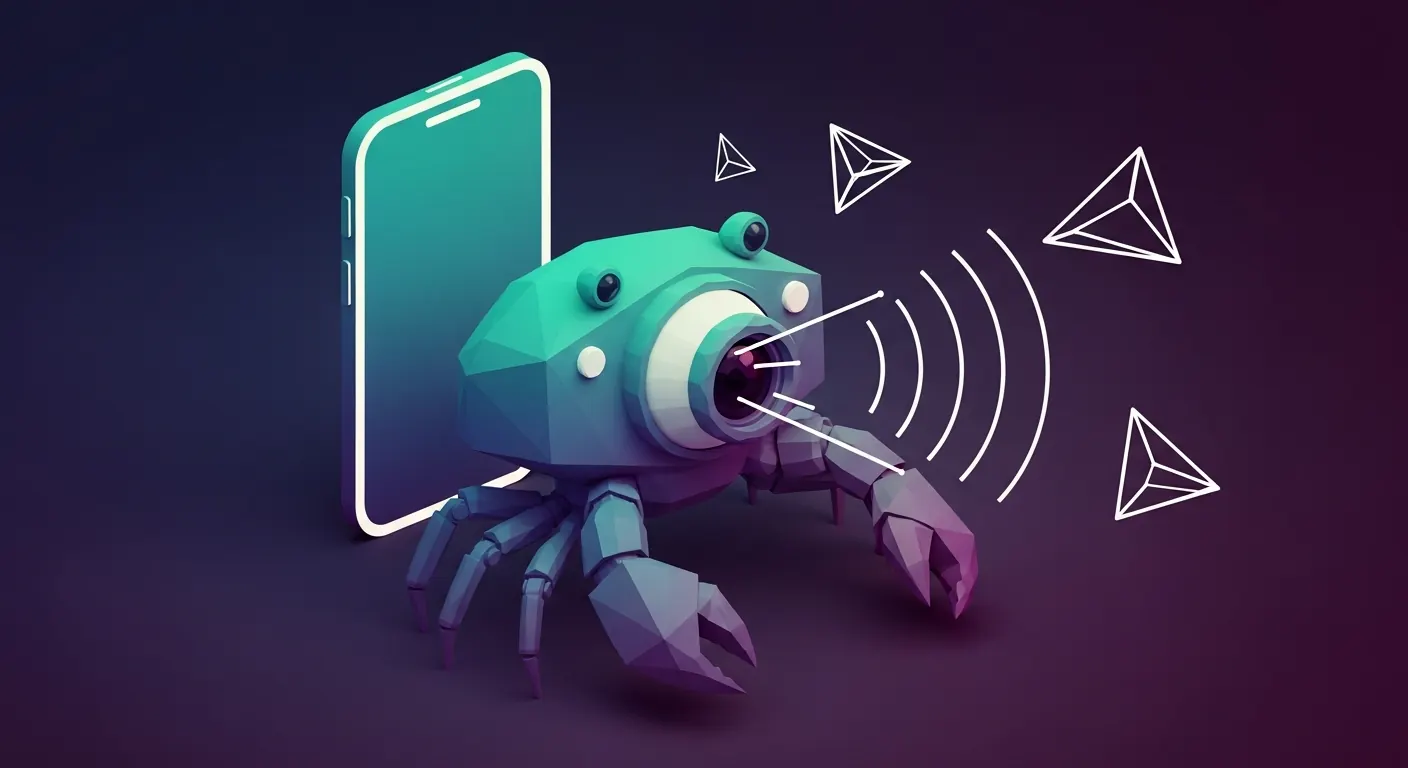
A new ecosystem project called Carapace launched this week with a straightforward pitch: OpenClaw can already think, search the web, run code, and manage files — but it cannot see what you see. Carapace fixes that.
The project surfaced on Hacker News this morning (story 48019383) under the tagline "Your OpenClaw Can See," and the site has enough detail to understand exactly what it is and is not.
What Carapace Adds
Carapace is a sensory layer that wraps around an existing OpenClaw install. It does not replace OpenClaw's reasoning; it feeds it richer input. The senses on offer:
- Vision Mode — Point your iPhone camera at anything (a plant, a wine label, a dishwasher error code, a mushroom) and ask. The agent answers with sources.
- Deep Scan — A 60-second context capture that stitches a panned scene into one rich query. Walk an aisle or sweep a room; the agent sees the whole thing.
- Sticker-Peel Focus — Pinch-zoom to isolate a specific object from a cluttered background before sending it to the model.
- Voice Mode — Natural back-and-forth with sub-second first-audio latency. Apple Speech transcription runs on-device.
- Place and Motion — The app knows you are at the hardware store before you say so, and knows you are walking versus driving. Context the agent gets for free.
- On-Device OCR — Apple Vision reads every word in frame before anything leaves the phone. Receipts, prescriptions, signage — text-first, image only if the agent needs it.
The Memory Architecture
The memory story is more ambitious than most AI apps. Carapace describes a layered cognitive model loosely inspired by neuroscience:
- Hippocampus — Episodic memory of specific moments, retrieved by time, place, or topic
- Place Cells and Grid Cells — Learns the shape of rooms, blocks, and routes you visit; distinguishes "your kitchen" from "a kitchen"
- Default Mode Network — Consolidates raw experience into stable schemas in the background between turns, similar to how sleep works for humans
Whether the neuroscience framing translates cleanly into a production system is a fair question, but the underlying claim — that the memory model is richer than a flat vector database of past chats — is plausible and interesting.
Pricing and Install
The install story is two commands on Linux or VPS:
curl -fsSL https://openclaw.ai/install.sh | bash
curl -fsSL https://carapace.info/install.sh | bash
The Mac app is a notarized DMG. The project claims non-destructive installation on existing OpenClaw setups — chats, keys, and identity files are preserved.
Pricing is structured around the number of OpenClaw gateways a single iPhone can pair with:
- Solo — Free forever, iPhone pairs with 1 gateway. Mac and Linux always unlimited.
- Power — $7.99 one-time in-app purchase, up to 10 gateways. Meta Ray-Ban beta for first 500.
- Corporate — $24.99 one-time, up to 50 gateways.
No subscription. You bring your own AI keys (Gemini, ChatGPT, Claude, Grok). Carapace itself does not see your data — it routes through your own hardware via Tailscale.
The Dashboard Features
Beyond vision and voice, Carapace ships a surprisingly full-featured agent control panel:
- Project Board — Live agent project tracking with per-workstream status and blockers
- Spinal Map — Real-time view of running agents and subagents
- Cron Tracker — Scheduled job health with RED/YELLOW/GREEN status and next-run ETAs
These overlap with OpenClaw's own Control UI dashboard, though the mobile-native UX and the integration with camera and location make Carapace a genuinely different surface for managing agents on the go.
Who This Is For
Carapace is not trying to compete with OpenClaw — it explicitly positions itself as additive. The install guide even starts with an openclaw.ai/install.sh step. The most obvious use cases are people who want their OpenClaw agent to work with the physical world: price-checking thrift finds, co-piloting home repairs with live camera guidance, or filing receipts on the fly.
The Meta Ray-Ban integration (in beta, later this year) is the most forward-looking piece — hands-free vision with the same OpenClaw backend would be a genuinely novel experience.
More at carapace.info.